

-
-
-
Application

-
Core Technologies
-
19
2024
-
12
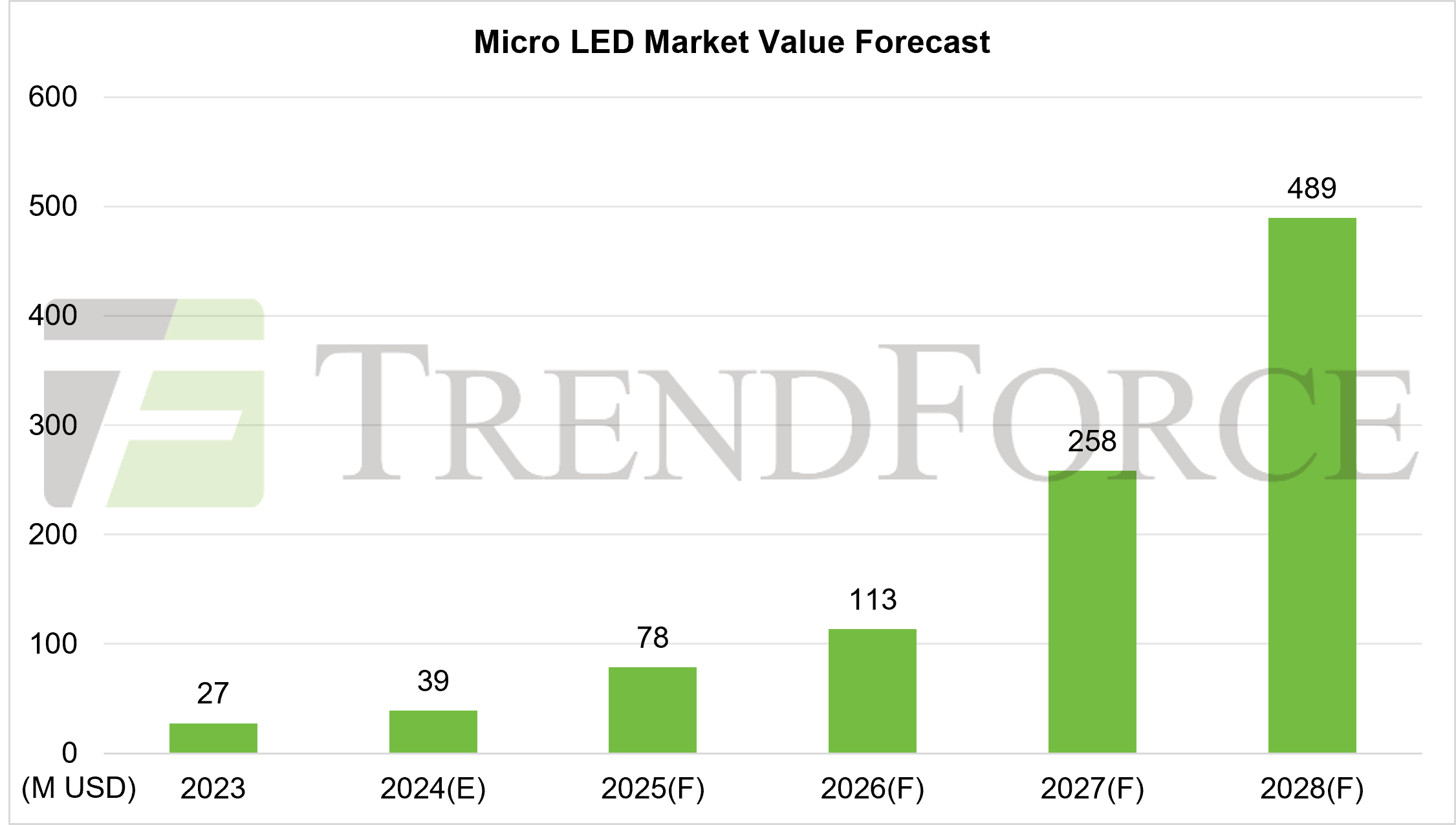
By 2028, AR and automotive applications will drive Micro LED chip revenues to $489 million.
TrendForce's report from TrendForce Consulting indicates that Micro is expected in 2024. LED Chip revenue is expected to reach approximately $39 million, with large displays continuing to be the primary driver of growth. Looking ahead, breakthroughs in key technological bottlenecks are on the horizon, while the growing adoption of automotive displays and the maturing full-color AR eyewear solutions are poised to propel Micro LED chip revenues to an impressive $489 million by 2028.
TrendForce notes that the Micro LED industry faces several key challenges in 2024. First, slow progress in chip miniaturization is hindering efforts to reduce costs. Second, the high price of Micro LED displays has led to weak end-user demand, limiting shipment volumes for large-sized displays already in production. Third, the focus within the wearable device market has shifted toward software optimization and seamless hardware-software integration. This, in turn, has diminished brands' incentives to innovate in hardware, slowing down the adoption of emerging display technologies like Micro LED. Finally, while automotive applications remain a critical growth area for Micro LED, they are still in the early stages of adoption and validation—making it difficult for them to contribute significantly to revenue in the near term.
From a technical perspective, addressing the challenges of seamlessly assembling large-format displays is critical. In the short term, boosting backplane production through alternative driving solutions can enhance efficiency and reduce costs. Looking ahead to the medium to long term, increasing the size of the backplane to minimize the number of components required could eliminate complex manufacturing steps, such as side wiring and TGVs (Through Glass Vias).
Additionally, in the design and manufacturing of Micro LED displays, maximizing light-extraction efficiency is becoming increasingly critical. Technologies such as microstructure and reflective-structure designs can optimize reflected light, minimizing light loss and boosting brightness.
TrendForce notes that as transfer-mass technology yields improve, new challenges have emerged in the inspection process. While the LED industry has already established testing methodologies, these solutions still require refinement to effectively address the extreme miniaturization and high-volume production of Micro LED chips. Overcoming these inspection challenges is now the industry's top priority.
Micro LED’s standout features—high brightness, high contrast, and high transparency—continue to draw significant investment from manufacturers. These capabilities enable Micro LED to be seamlessly integrated into transparent displays embedded in car windows or incorporated as part of AR-HUD or P-HUD systems, addressing the growing demand from drivers and passengers for a smooth integration of virtual and real-world information. Moreover, combining Micro LED with silicon substrates offers a robust solution for near-eye displays in AR glasses, positioning Micro LED as the benchmark for next-generation, metaverse-focused head-mounted devices.
TrendForce emphasizes that the commercialization of Micro LED technology should not rely too heavily on the mature consumer electronics market. Instead, manufacturers should leverage Micro LED’s unique display capabilities by pairing them with a variety of sensor solutions, enabling devices to deliver innovative new features and uncovering imaginative niche applications. This strategic approach is expected to accelerate Micro LED’s market penetration across diverse sectors, further driving growth and fostering innovation.
Contact us
Address: Gaoxin 4th Road, Gedian Economic-Technological Development Area, Ezhou City, Hubei Province